Executive Highlights
• Junior and mid-tier mining projects face persistent financing constraints due to market volatility, regulatory risk, and long development timelines.
• Diversified financing models, targeted government incentives, and streamlined permitting can significantly improve project bankability.
• Strategic public-private partnerships and ESG integration are critical to attracting long-term global capital.
• Innovation, technology adoption, and workforce capability—particularly in mining-specific financial reporting—are essential to de-risk investment.
• Canada has a strong opportunity to position itself as a globally competitive destination for critical minerals investment by aligning capital, policy, and talent.
____________________________________________________________________________________________________________
1. Promote Alternative Financing Mechanisms
Traditional equity and debt markets remain challenging for junior and mid-tier miners due to volatility and perceived risk. To address capital constraints, policy frameworks should support diversified financing options beyond conventional lending.
Royalty and streaming agreements provide upfront capital in exchange for future production, reducing equity dilution and debt burdens. These instruments are widely used in gold mining and are expanding into copper and lithium projects. Private equity and specialist mining funds—such as Resource Capital Funds or Appian Capital—offer not only capital but also technical and operational expertise throughout exploration, development, and production stages. Offtake-linked financing ties project funding to long-term purchase agreements with end-users, including battery manufacturers and technology firms, significantly improving revenue certainty.
Policy idea: Establish government-backed guarantees or co-investment funds to crowd in private capital and accelerate the use of these alternative financing structures.
2. Leverage Incentives for Critical Minerals Projects
Rising global demand for lithium, copper, nickel, and rare earth elements underpins the energy transition and industrial electrification. Despite strong fundamentals, financing gaps persist for exploration, feasibility, and early development.
Canada’s existing flow-through share regime has proven effective for junior miners and should be expanded alongside targeted tax credits and accelerated depreciation. Grants or low-interest loans for feasibility studies and ESG-aligned development would further reduce early-stage risk. In addition, thematic or sustainability-linked bonds offer a growing opportunity to attract institutional investors focused on green assets and long-term value.
Policy idea: Develop a national critical minerals strategy with dedicated financing windows, similar to U.S. Department of Energy initiatives or Australia’s Critical Minerals Facility.
3. Streamline Regulations and Permitting to Reduce Risk
Lengthy, uncertain approval timelines remain a major deterrent to investment and undermine project bankability. Predictable and efficient regulatory processes are essential to restoring investor confidence.
One-stop permitting agencies or fast-track approval pathways for strategic and critical mineral projects would significantly reduce administrative delays. Aligning environmental and social requirements with international benchmarks—such as IFC Performance Standards—can maintain high protections while improving global investor confidence.
Policy idea: Introduce partial government guarantees for political or environmental risks to unlock commercial bank lending and institutional capital.
4. Strengthen Public-Private Partnerships and Government Support
Targeted government participation can materially de-risk early-stage mining projects and catalyze private investment. Sovereign funds or development banks can take minority equity positions or provide blended finance, sharing risk without crowding out private capital.
Partnerships with multilateral institutions such as IFC or EXIM further enhance credibility and access to global financing. Strategic offtake arrangements with government stockpiles or industrial buyers can also provide long-term revenue certainty.
Policy idea: Launch a matched-funding program in which government capital matches private investment in high-priority mineral projects.5. Enhance ESG Integration to Attract Global Capital
Strong ESG performance increasingly reduces capital costs and broadens access to global investment pools. Investors now expect transparent, verifiable sustainability performance across the mining value chain.
National certification and traceability schemes for responsible mining would improve market access and brand value for Canadian projects. Incentives for circular economy initiatives—such as byproduct recovery from mining waste—can further enhance sustainability outcomes.
Policy idea: Link fiscal incentives to measurable ESG metrics to attract ESG-focused institutional investors.
5. Foster Innovation and Technology Adoption
Advanced technologies improve efficiency, reduce operating costs, and strengthen project finance ability. AI-driven exploration, automation, and low-impact processing can materially improve project economics.
Government support for R&D grants, innovation hubs, and tax incentives for adopting green and digital mining solutions would accelerate commercialization and adoption.
Policy idea: Fund pilot programs for “mine of the future” concepts to attract technology-oriented investors and strategic partners.
Collectively, these measures balance capital attraction—particularly for junior and greenfield projects—while addressing commodity volatility, regulatory risk, and ESG scrutiny. They position Canada as a globally competitive destination for mining investment.
7. Specialized Training for Accountants in Mining and Natural Resources
High-quality financial reporting and risk management are critical to attracting capital, yet mining’s complexity demands skills beyond general accounting. A targeted training program would significantly improve transparency, project bankability, and investor confidence.
Key areas should include mining-specific accounting standards (including IFRS 6), cost allocation across the mine lifecycle, financial modeling under commodity volatility, risk management and hedging, ESG and sustainability reporting, metallurgical and production accounting, and mining-specific tax and regulatory compliance.
Policy idea: Partner with professional bodies (such as RPA or CPA associations) and universities to deliver certified, subsidized programs that build sector-specific financial expertise.
This initiative directly supports de-risking investment by strengthening financial governance and transparency across the mining value chain.
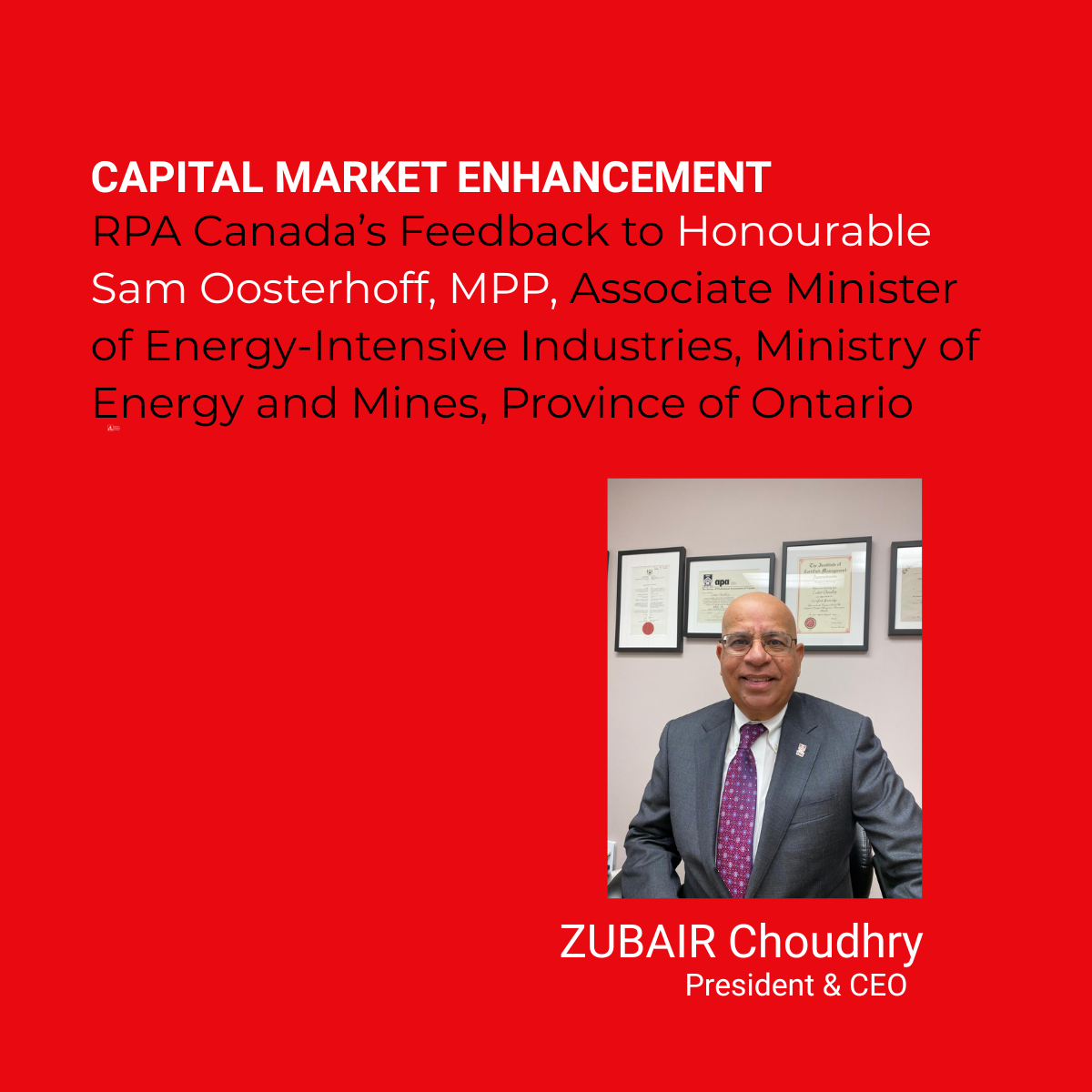
Prepared & presented by:
Zubair Choudhry, RPA, APA, FCMA (ANZ)
President & CEO, RPA Canada
Dated: December 17, 2025
President@rpacanada.org
www.rpacanada,org
